Control
Create the conditions
The leader does not command every answer: they make listening, autonomy and learning possible.
A practical reading of the LUMIA Lotus
Leading like life.
Regenerative leadership begins when a company stops asking only how to ‘do less harm’ — and learns to repair, nourish and develop the living conditions on which it depends.
Not a moral posture. Not another label. A way of deciding, cooperating and creating value.
Scroll to explore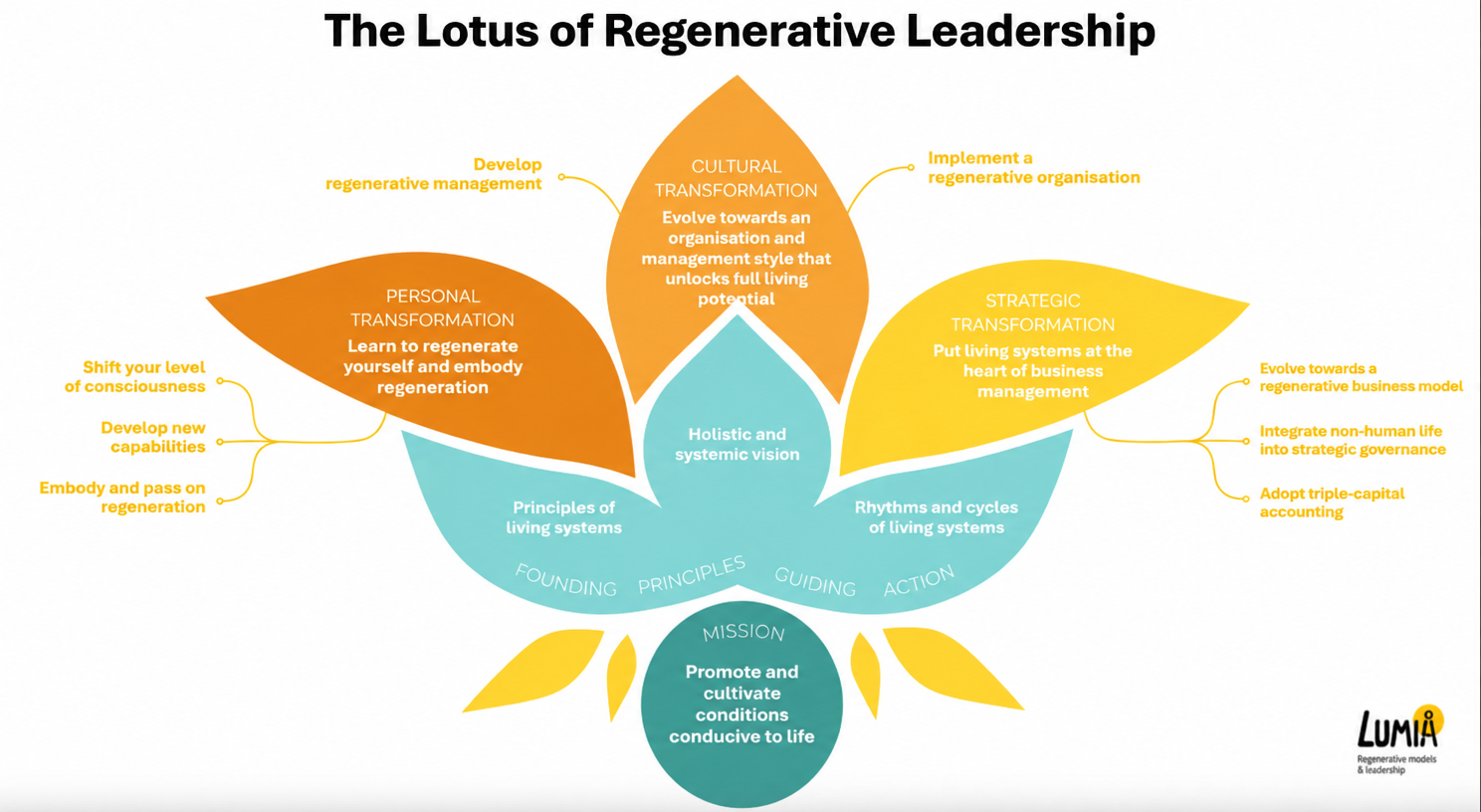
01 · The shift
Sustainability often seeks to limit the damage of an unchanged model. Regeneration asks a more demanding question: how can our activity strengthen the people, places and ecosystems that make it possible?
Create the conditions
The leader does not command every answer: they make listening, autonomy and learning possible.
Care for the system
A decision is no longer judged only on local gain, but on its human, ecological and economic effects over time.
Restore capacity
The ambition goes beyond ‘less bad’: people and places become more able to act, adapt and renew themselves.
02 · The Lotus in motion
The Lotus does not describe three separate programmes. Leadership stance transforms collective practices; those practices make a different strategy possible; that strategy in turn gives people the means to act.
Personal metamorphosis
Explore a metamorphosis
The Lotus of Regenerative Leadership — LUMIA. English edition of the supplied original diagram; practical business interpretation below.
The leader
Learn to regenerate oneself and embody regeneration.
Starting culture
Control, accelerate, extract resources
Emerging culture
Listen, regenerate, develop potential
Develop resilience and awareness of interdependencies; practise listening, protect recovery time and acknowledge what you do not know.
Leadership example legitimises care, debate and questioning. Living systems are no longer seen merely as resources.
Tensions can be expressed without punishment; overload signals are addressed; decisions incorporate feedback from the field.
The question that changes the executive conversation
« Which leadership behaviour currently makes cooperation or truth difficult? »
One industrial case, three complementary levers · Facing water stress at a site, the leader listens to employees and neighbours before imposing a technical solution.
Teams and the organisation
Evolve management and the organisation to unlock full living potential.
Starting culture
Silos, obedience, individual performance
Emerging culture
Cooperation, autonomy, collective learning
Create cross-functional dialogue, share responsibilities and clarify decisions; turn experimentation and feedback into regular rituals.
Listening becomes a collective practice, not just an individual quality. Teams can shape their work and resolve tensions with partners.
Trade-offs are made across functions; teams have explicit decision rights; lessons learned genuinely change practices.
The question that changes the executive conversation
« Where can teams decide without waiting for hierarchical permission? »
One industrial case, three complementary levers · Operations, procurement and neighbours jointly develop a watershed plan with shared responsibilities and review meetings.
The business model and governance
Put living systems at the heart of how the business is run.
Starting culture
Reduce the footprint without changing the model
Emerging culture
Create value by regenerating conditions for life
Rethink the offer and procurement; represent non-human living interests in decisions; evaluate projects across human, natural and financial capital.
Cooperation shapes budgets, products and investments. Regeneration becomes a core-business criterion rather than a peripheral CSR project.
Investments are adjusted to ecological limits; water, biodiversity and wellbeing are tracked alongside finances; results shape subsequent decisions.
The question that changes the executive conversation
« Which investment would change if living systems genuinely had a voice in the trade-off? »
One industrial case, three complementary levers · The executive committee funds water and material loops and watershed restoration; the business model and its indicators account for effects on the territory.
03 · The foundation
Without systemic vision, personal metamorphosis becomes isolated self-development. Without living-systems principles, cooperation remains a productivity tool. Without cycles of recovery and renewal, transformation exhausts the very people it claims to unlock.
Living-systems principles
Holistic and systemic vision
Living rhythms and cycles
The Lotus mission
People develop their potential, teams cooperate and the business model contributes to territorial health: promoting and cultivating conditions favourable to life.
A living feedback loop
04 · In practice
It does not ask leaders to be perfect. It asks them to make interdependencies, tensions and trade-offs visible — then act on the system producing the results.
A leader can say ‘I don’t know’ without losing authority.
A tension between functions becomes an explicit trade-off, not a turf war.
Recovery and quality of attention are treated as conditions for performance.
Impacts on people and ecosystems enter the same reviews as the P&L.
A profitable project that degrades a territory’s future capacity is genuinely debated — and sometimes declined.
From framework to practice
An executive conversation to examine your trade-offs, governance practices and next transformation through the Lotus.
Self-assessment: explore my regenerative competenciesFramework source: The Lotus of Regenerative Leadership — LUMIA. The executive questions, business translations and observable signs presented here are SunriseHQ’s practical interpretation, distinct from the original diagram.